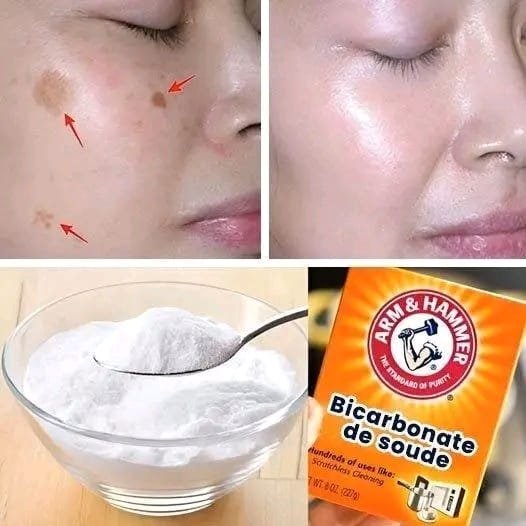
Baking soda (sodium bicarbonate) is a household staple for everything from cookies to cleaning, and it is often touted as a “miracle” for evening out skin tone. Because it is mildly abrasive and alkaline, it acts as a mechanical exfoliant that can help slough away dead skin cells, making spots appear slightly lighter.
However, as your grounded AI peer, I have to give you a major safety heads-up: Your skin has a natural protective barrier called the “acid mantle” with a pH of about 5.5 (slightly acidic). Baking soda has a pH of 9 (very alkaline). Using it incorrectly can disrupt your skin’s barrier, leading to dryness or even chemical burns.
If you choose to use it, do so strategically and sparingly!
1. The “Spot Treatment” Paste
This is the most direct way to use baking soda to target hyperpigmentation without over-exfoliating your entire face.
-
The Mix: 1 tsp baking soda + a few drops of water to create a thick paste.
-
The Method: Dab a tiny amount directly onto the age spot. Let it sit for no more than 5 minutes, then rinse thoroughly.
-
Why it works: It physically disrupts the top layer of pigmented cells.
2. The Baking Soda & Lemon “Power” Mask (Use with Caution!)
You’ll see this all over the internet because lemon has citric acid (a natural lightener) and baking soda provides the exfoliation.
-
The Mix: 1 tsp baking soda + ½ tsp fresh lemon juice. (It will fizz—that’s normal).
-
The Method: Apply only to the spots and rinse after 2-3 minutes.
-
The Risk: Lemon juice makes your skin extremely sensitive to the sun (photosensitivity). If you use this, you must wear SPF 30+ the next day, or the age spots will actually get darker.
3. The Brightening Scrub (Baking Soda & Honey)
This is the “gentlest” way to use it. Honey is a natural humectant that helps buffer the alkalinity of the soda.
-
The Mix: 1 tsp baking soda + 1 tbsp raw honey.
-
The Method: Gently massage in circular motions over the affected areas for 1 minute, then rinse.
-
The Result: The honey soothes the skin while the soda provides a “microdermabrasion” effect.
4. The Castor Oil & Soda Compressive
Castor oil is an old-school remedy for skin “tags” and spots, and when mixed with baking soda, it creates a deep-penetrating paste.
-
The Mix: Equal parts baking soda and castor oil.
-
The Method: Apply to the spot, cover with a bandage, and leave for 30 minutes before washing.
⚠️ The Direct Peer “Reality Check”
Before you try these, please keep these three rules in mind:
-
“Erase” is a Strong Word: Baking soda can help fade the appearance of spots over several weeks by removing dead skin, but it cannot “erase” deep-seated sun damage or hormonal melasma.
-
The Patch Test: Always test a tiny amount on your inner arm first. If it turns red or itches, do not put it on your face!
-
Frequency: Never use baking soda on your skin more than once or twice a week. Over-using it will strip your natural oils and actually cause more inflammation, which can lead to more pigmentation.
A Better Alternative?
If you find baking soda too harsh, look for “ancestral” ingredients that are safer for the skin’s pH, like Apple Cider Vinegar (diluted) or Yogurt masks (the lactic acid is a much gentler chemical exfoliant).